
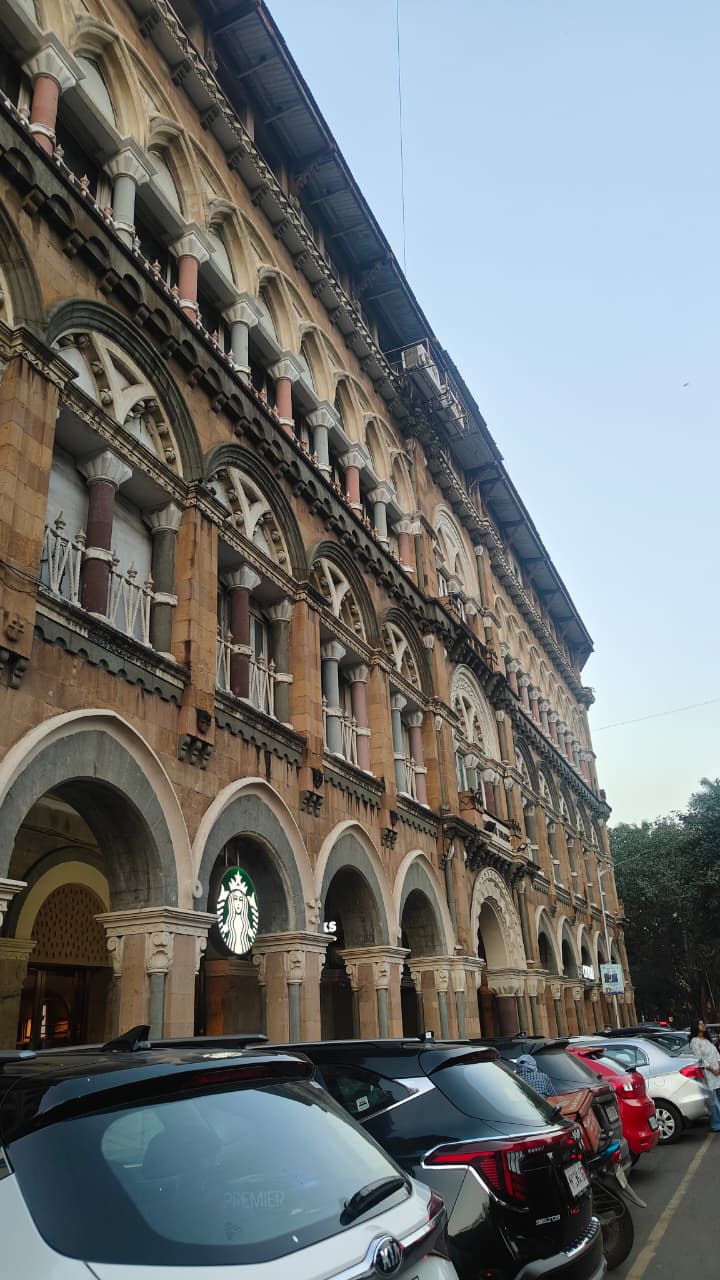
You’ve probably walked past it. Or queued inside it. Maybe you’ve photographed the arched verandah from the outside without knowing what you were looking at.
The Elphinstone Building at Horniman Circle is one of Fort Mumbai’s most overlooked landmarks. Not because it’s hidden. Because Starbucks moved in.
On October 19, 2012, Ratan Tata and Howard Schultz stood inside a 142-year-old Venetian Gothic building in the heart of Fort Mumbai and opened India’s first Starbucks. Most people who visit that store today know none of what came before. They’re there for the coffee. That’s a shame, because the building has a story that started 101 years before Starbucks was even founded.
The Building That Came First
The Elphinstone Building was completed in 1870. Starbucks was founded in 1971. The building is older than the brand by a century.
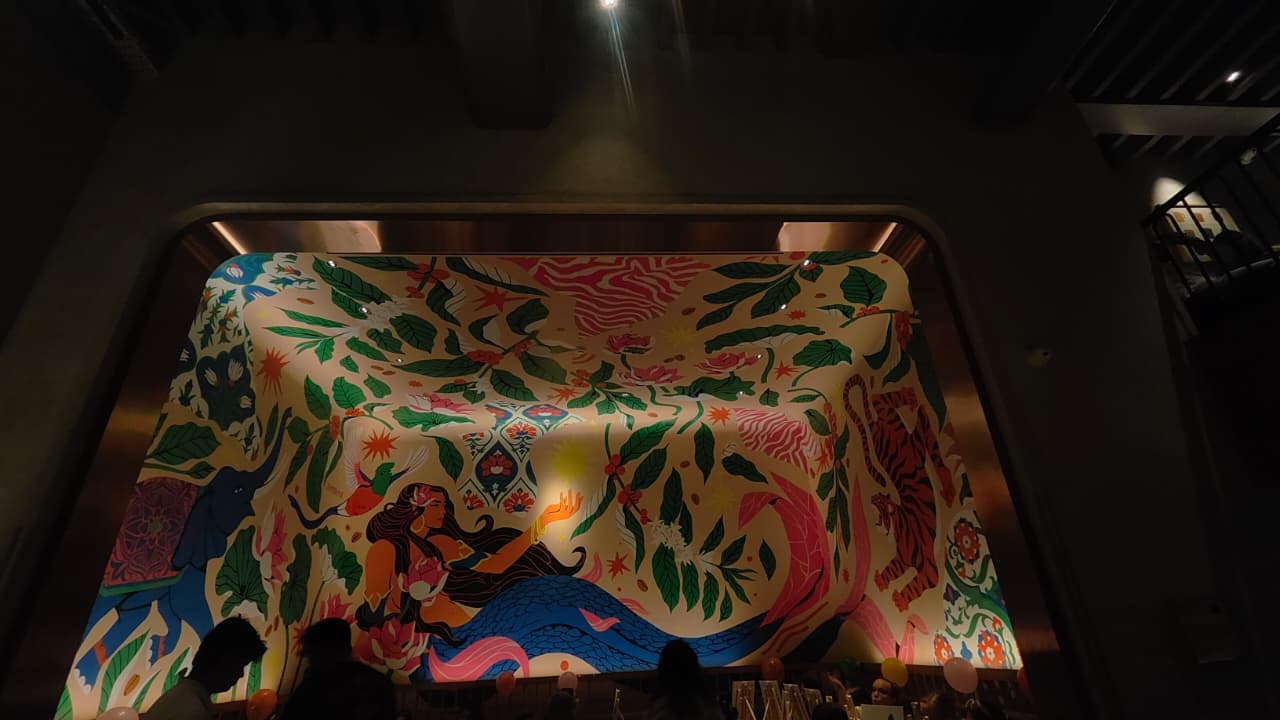
Inside the Elphinstone Building Starbucks Reserve. The art on the walls is as layered as the building’s history.
Designed by architect Rienzi Giesman Walton in Venetian Gothic palazzo style, the building was constructed from yellow Malad stone, the same warm sandstone used in Watson’s Hotel, the Army and Navy Buildings, and Elphinstone College nearby. When it was completed, it housed the Chartered Mercantile Bank on its ground floor.
It was named after Mountstuart Elphinstone, one of the more consequential figures in Bombay’s history. He served as Governor of Bombay from 1819 to 1827, drafted a new code of laws, and built an education system genuinely accessible to Indians, something unusual enough at the time that people named two institutions after him. The college still exists. So does the building.
In 2018, the Elphinstone Building was included in UNESCO’s Victorian Gothic and Art Deco Ensembles of Mumbai, a World Heritage designation covering the historic Fort precinct. A UNESCO-listed building. Currently serving oat milk lattes.
Mountstuart Elphinstone, whose name is on the building, died in 1859, more than a decade before it was constructed. He never saw it. He also turned down the position of Governor-General of India. Twice. He preferred to finish writing his two-volume History of India.
The Ground Beneath the Coffee
To understand why this location matters, you need to know what stood here before any of these buildings existed.
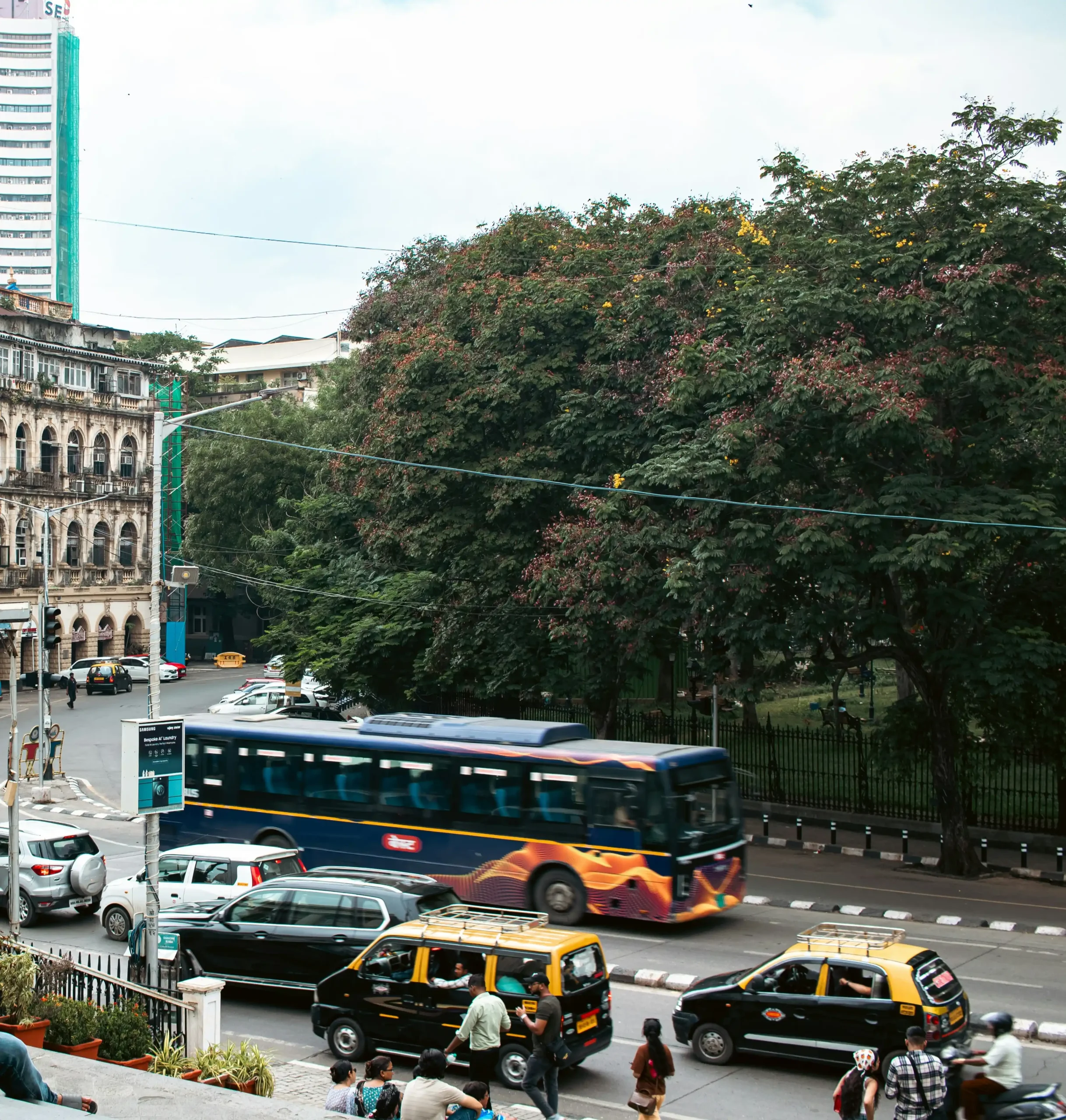
Horniman Circle today. A peaceful garden where a cotton trading ground once stood.
Horniman Circle was not always a garden. For most of the early 1800s, this entire area was called Bombay Green, an open trading ground where cotton and opium changed hands. It was loud, chaotic, and extraordinarily profitable.
When the American Civil War broke out in 1861 and cut off cotton supplies from the Confederate states to Britain, Bombay’s cotton prices exploded. The value of cotton exports from Bombay to Britain jumped from Rs. 16 crore to Rs. 40 crore between 1861 and 1865. The merchants who traded on this very ground became some of the wealthiest people in Asia in a matter of years.
In the 1850s, stockbrokers began gathering informally under a banyan tree on what is now Dalal Street, fuelled by the same cotton fortunes. By 1875, that informal gathering had formalised into the Native Share and Stock Brokers’ Association. That association became the Bombay Stock Exchange, the oldest in Asia.
The ground under your Starbucks cup seeded modern India’s financial system.
41 Years Late to a Billion-Person Market
Starbucks was founded in Seattle in 1971. It had been operating for 41 years before entering India. In that time, it expanded to dozens of countries across Asia, Europe, Latin America, and the Middle East. India, one of the world’s most populous nations, came late.
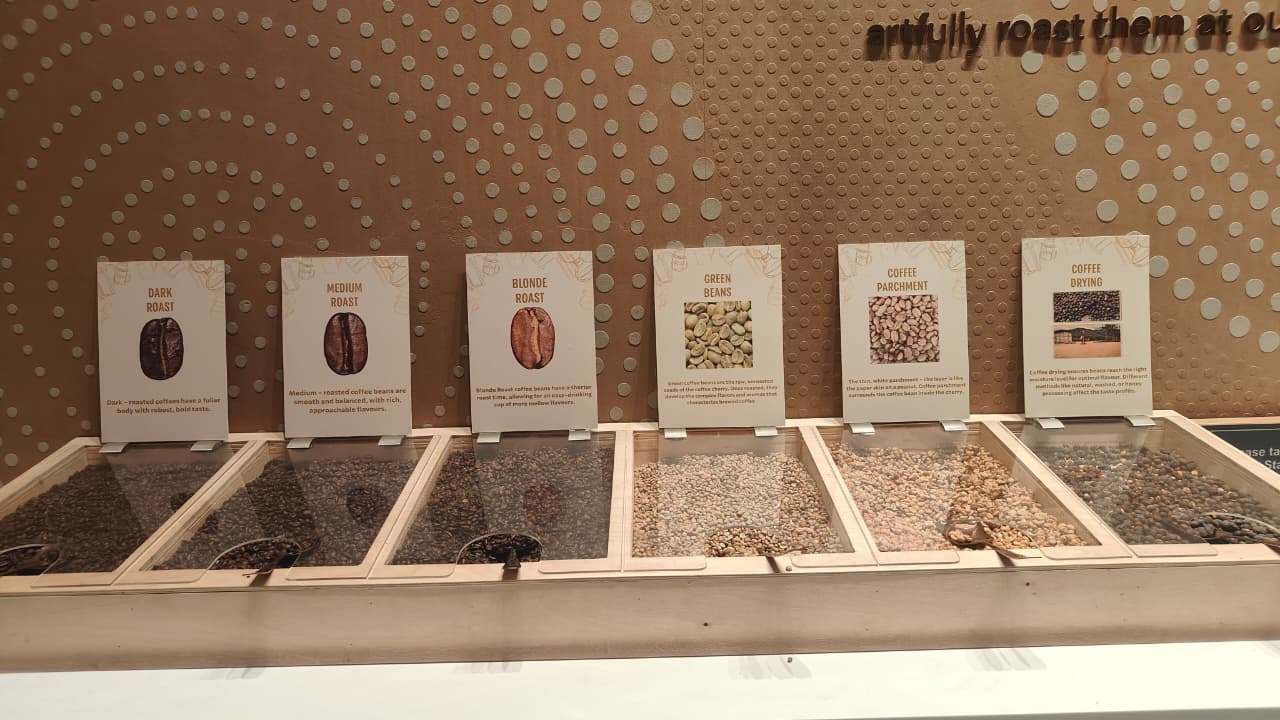
Coffee beans on display at the Horniman Circle store. India’s first Starbucks was also the first in the world to source and roast its espresso entirely within the country.
The joint venture with Tata was announced on January 30, 2012, a 50:50 partnership between Starbucks Coffee Company and Tata Global Beverages. They named the company Tata Starbucks Limited. Every outlet opened under the branding: “Starbucks Coffee, A Tata Alliance.”
The choice of Tata was strategic. Tata Coffee Limited had estates in Coorg and Chikkamagaluru. For the first time, Starbucks opened a store serving espresso sourced and roasted entirely within the country it was selling in. The Horniman Circle store was the first Starbucks anywhere in the world to do that.
Howard Schultz, Starbucks CEO at the time, was present at the opening. He called it “perhaps the most elegant, beautiful, dynamic store we’ve opened in our history.” In his essay later published in the book Reimagining India, Schultz wrote that at the celebratory dinner that evening, Ratan Tata offered a toast that moved him to tears. He described Tata as “a man with so much grace.”
It started with one 4,500 square foot, two-level store in a 142-year-old building at Horniman Circle. By the end of opening week, two more had opened at Oberoi Mall and the Taj Mahal Palace Annexe. Then Delhi. Then the rest of the country.
Ten Years Later, Same Building, Different Store
On October 19, 2022, exactly ten years to the day from the original opening, Tata Starbucks converted the Horniman Circle store into India’s first Starbucks Reserve.
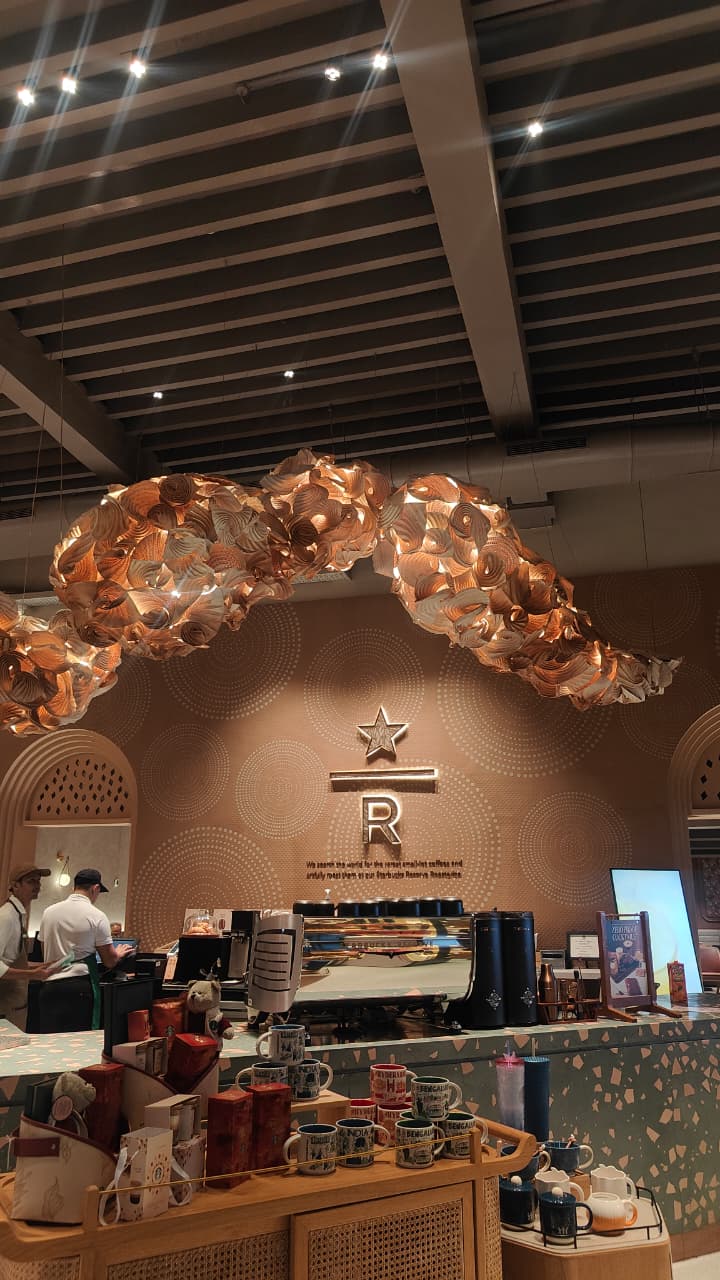
The Reserve experience: rare single-origin beans, specialty brewing methods, and Certified Coffee Masters at the original Fort Mumbai store.
A Starbucks Reserve is not a regular Starbucks. It serves rare, single-origin coffees sourced from small family farms and estate plantations, brewed using methods like siphon, Chemex, and pour-over, guided in-store by Certified Coffee Masters. The menu is exclusive. The experience is closer to a specialty coffee bar than a chain.
For three years, this one store in a 150-year-old Fort Mumbai building was the only Starbucks Reserve in the entire country. The second one opened in Gurgaon on November 23, 2025, coinciding with Tata Starbucks’ 500th store milestone.
The same building that opened as India’s first Starbucks on October 19, 2012, became India’s first Starbucks Reserve on October 19, 2022. The date was not a coincidence.
What the Building Has Seen
Here is a partial list of things that happened in this neighbourhood before Starbucks arrived.

Fort Mumbai, the neighbourhood that built modern India, then got a Starbucks.
The building across the circle, Brady House, was where the Times of India had its offices. Next to it, the Bank of Bombay laid its foundation stone in 1864. A short walk away, Watson’s Hotel hosted India’s first public film screening in 1896, when the Lumière Brothers screened six films to a Bombay audience, months after their Paris premiere.
The garden at the centre was planned in 1869 and completed in 1872. It was renamed Horniman Circle in 1968, after Benjamin Horniman, an English journalist who edited The Bombay Chronicle and defied British censorship to publish news of the Jallianwala Bagh massacre in 1919, despite being a British citizen himself.
In 1858, inside the Town Hall just around the corner, Lord Elphinstone read Queen Victoria’s Proclamation abolishing the East India Company, ending 258 years of Company rule in India.
All of this, in the same few square blocks where you are currently deciding between a flat white and a cold brew.
The Story Nobody Orders
The Elphinstone Building Starbucks has good coffee. But the building is extraordinary.
It survived the demolition of Bombay Fort. It survived the cotton crash, two World Wars, Independence, and seven decades of a new country figuring itself out. It earned a UNESCO designation in 2018. It opened as India’s first Starbucks and became India’s first Starbucks Reserve, both on October 19, exactly ten years apart.
And it is currently serving a Caramel Frappuccino to someone who has no idea any of this happened.
That is Fort Mumbai in one image. The stories are everywhere. Most people just don’t know to look. If you want someone to point them out, that’s what we do.
Some Stories Are Better Walked Than Read
We pass the Elphinstone Building on every walk. Come hear the part that isn’t on the Starbucks menu.
Explore Fort Untold